The multiplier reads 3.7x. Your thumb is on Cash Out. The chicken clears another gate, 3.9x, and some quiet voice suggests that 4x would be a rounder number. You wait. The train does not. One second later the round is over, the stake is gone, and you are already tapping the bet button again, mildly annoyed at a cartoon bird.
If that sequence feels familiar, this page is for you. You already know what a crash game is, so this is not another three-lanes-and-multipliers summary. It is an honest look at why Chicken Subway is so hard to stop at the right moment: how the RNG actually decides rounds, what lane selection does and does not control, why cashing out at 3x feels harder than it should, and which behavioural traps the design leans on. The short version: developer 100HP Gaming, RTP 96-98%, genre lane-selection crash, an instant runner with betting attached. The long version follows.
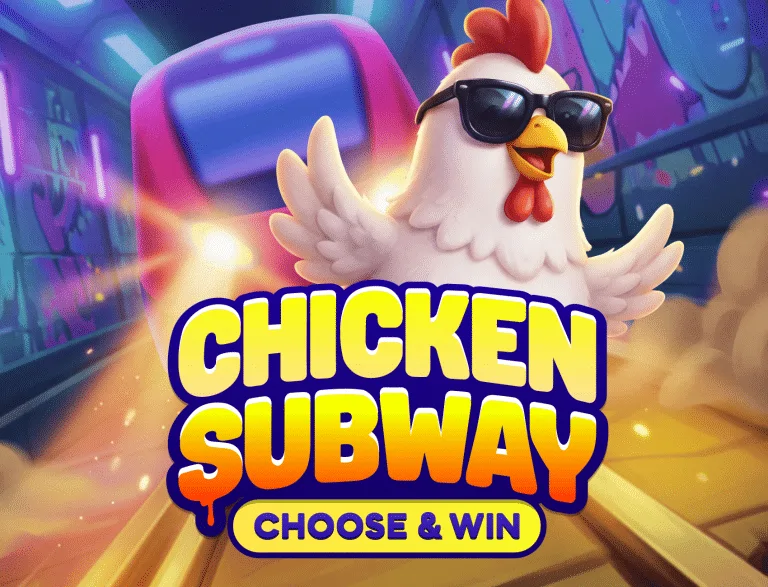
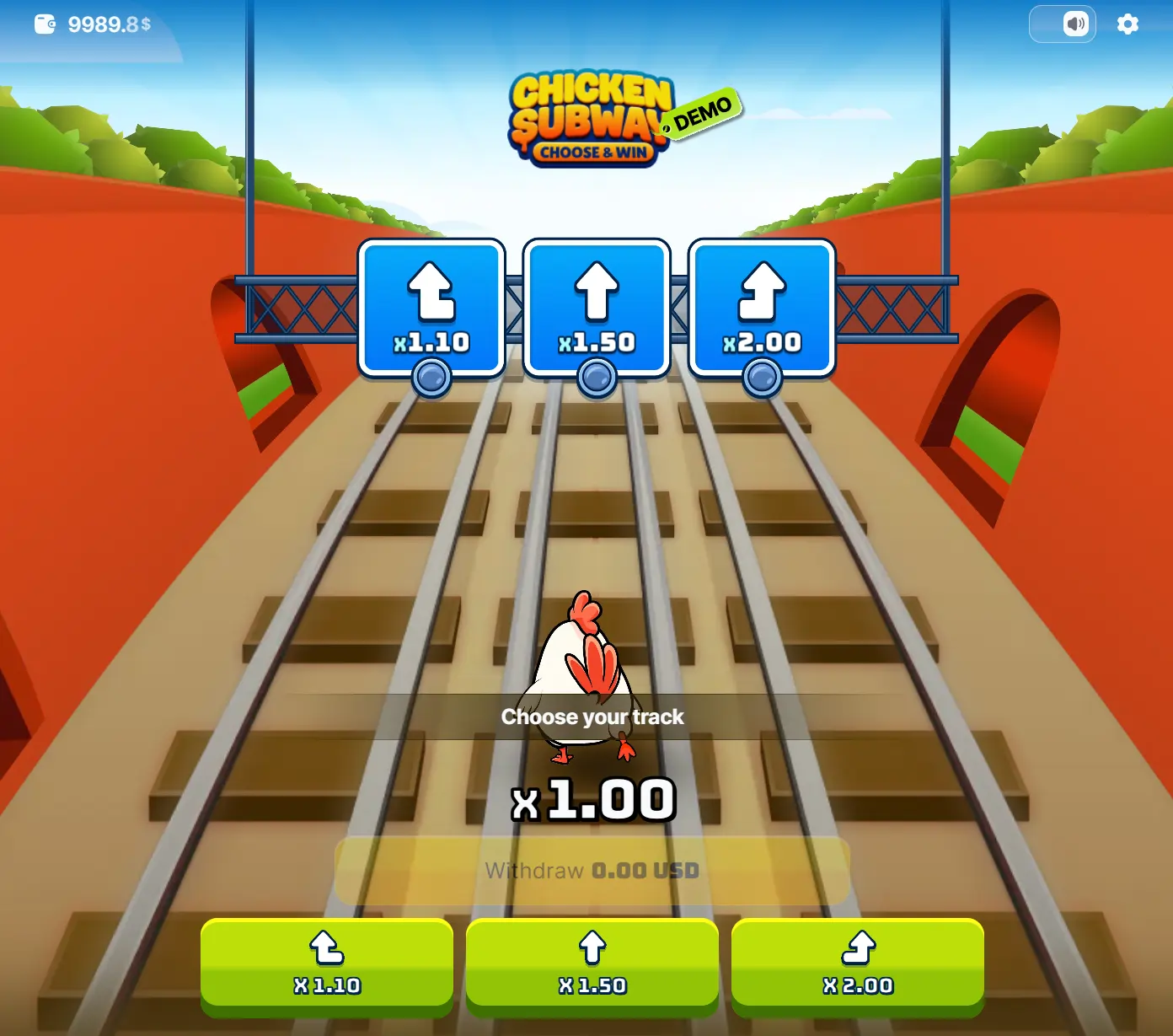
In one paragraph: Chicken Subway is an instant crash game by 100HP Gaming, released in December 2025. You place a bet, a chicken runs across three subway tracks, and each gate it passes raises your multiplier. Cash out at any point to bank your stake times the current figure; a train ends the round and the stake. Unlike graph-based crash games, you make an active lane choice at every step, which is where the game’s tension and psychology live. Rounds last 15-30 seconds, and the free demo runs the same maths as real play.
Spec
Value
Why it matters
Developer
100HP Gaming
A studio specialising in fast instant titles; the design here is deliberate
Game type
Lane-selection crash / instant runner
Several decisions per round, not one
RTP
96-98%
Long-run return; one session can sit far from it
Bet range
£0.10 – £150 per round
Stake size, not lane choice, controls your variance
Max win
Capped at £10,000 per round
A hard ceiling; beyond it, risk without reward
Round length
15-30 seconds
Short rounds stretch sessions; see below
Mobile
HTML5, browser-based, no APK
Runs anywhere; downloadable ‘apps’ are not official
Provably fair
Yes (SHA-256 seed verification)
Verifiable proof the result pre-dated your choices
What Chicken Subway Actually Is (and What It Isn't)
Start with what it is not. It is not a slot: there are no reels, no paylines, no bonus rounds, and nothing spins. It is also not a standard crash game in the Aviator mould, where a curve climbs, you make exactly one decision per round (when to leave), and everything else is spectating.
What it is belongs to a newer branch of the family: the lane-selection instant game. Released by 100HP Gaming in December 2025, Chicken Subway keeps the core crash proposition, a multiplier that grows until something ends the round, but replaces the passive graph with an active runner. At each step, three gates appear with different multipliers, and you choose which track the chicken takes. Then you face the same choice again. And again. A single round can involve half a dozen decisions where Aviator involves one.
That difference is the whole identity of the game. More decisions per round means more moments where your judgement feels involved, which makes it more engaging than watching a curve and, as we will see, more psychologically sticky. Its closest mechanical relatives are step-based games like Mines, not the graph crashes it is usually lumped in with. If Aviator is watching a kettle, Chicken Subway is cooking: no more under your control, but your hands are busier.
The Lane Selection Mechanic: Skill or Illusion?
Here is the part most pages skip. Every round’s outcome is determined by the random number generator before the chicken takes a single step; the bust point exists the moment you press Run. Lane selection chooses between pre-calculated thresholds: the higher-multiplier gate carries a higher chance this is the step where the round ends. You are selecting a risk profile from a menu, not steering around trains.
So is it skill? Not in the sense of influencing the RNG; nothing you tap changes what was already generated. It is skill only in the drier sense of consistently choosing risk levels that match your plan, closer to discipline than dexterity. The animation works hard to suggest otherwise, and that gap between what your hands feel and what the maths does gets a full section below.
Can you check the outcome really was fixed in advance? That is what provably fair means, minus the jargon. Before the round, the server generates a secret seed and shows you its SHA-256 fingerprint (a hash). Your device adds a client seed, a round counter called a nonce joins them, and together these produce the result. After the round the server reveals its seed; recombine the pieces and the hash must match what you saw before playing. If it does, nobody moved a train after your bet.
One framing note: this is not an operator’s excuse. Knowing the outcome is pre-set tells you exactly where your influence lives: stake size, target multipliers, and when you stop. Everything else is theatre, admittedly rather good theatre.
Chicken Subway RTP and Odds
The published RTP is 96-98%: across an enormous number of rounds, the game returns £96-£98 of every £100 staked. The phrase doing the heavy lifting is enormous number. Over 20,000 rounds, results grind towards that figure with statistical inevitability. Over your 20 rounds on a Tuesday evening, RTP is close to irrelevant: doubling your money and losing all of it are both entirely consistent with a 97% game. RTP describes the ocean, not your bucket of it.
The flip side is the house edge of 2-4%. For context, European roulette holds 2.7% and typical online slots keep 4-8%, so Chicken Subway sits at the friendlier end of the room, roughly level with roulette and comfortably ahead of most slots. Friendlier, note, is not friendly: the expected value of every round remains negative.
The payout arithmetic itself is refreshingly simple. Stake £10, cash out at 3x, receive £30, of which £20 is profit. No paytables, no symbol weights. What the arithmetic will not do is tell you when the good and bad stretches arrive. Variance has no schedule, and any pattern you think you have spotted across ten rounds is your brain doing what brains do, which brings us neatly to the next sections.
How to Play Chicken Subway: Inside a Round, Step by Step
Set your stake (£0.10 to £150). Quietly the most important decision of the round: stake size controls your exposure to variance far more than any lane will. A £1 bet and a £50 bet face identical odds; only one can end your session in ten minutes.
The 5-second timer starts. Time pressure is not decoration; it is a design tool. Under a countdown, people default to gut decisions and abandon plans they made calmly, which is precisely why your targets should be set before this timer exists.
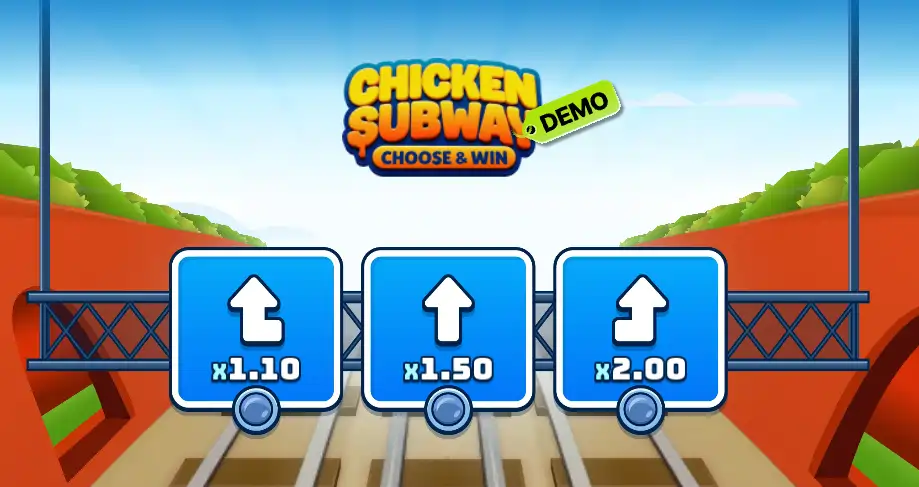
Choose a lane. Three tracks, three displayed multipliers, three pre-set bust thresholds. Higher number, higher chance this step ends the round. You are picking from a menu of risk, not threading a needle.
The multiplier climbs. This is where the real decision happens, not at the button. Each gate silently reframes your target: 3x felt sensible a moment ago, but now it is right there and 4.5x is visible. Notice the reframing; it is the game’s main lever.
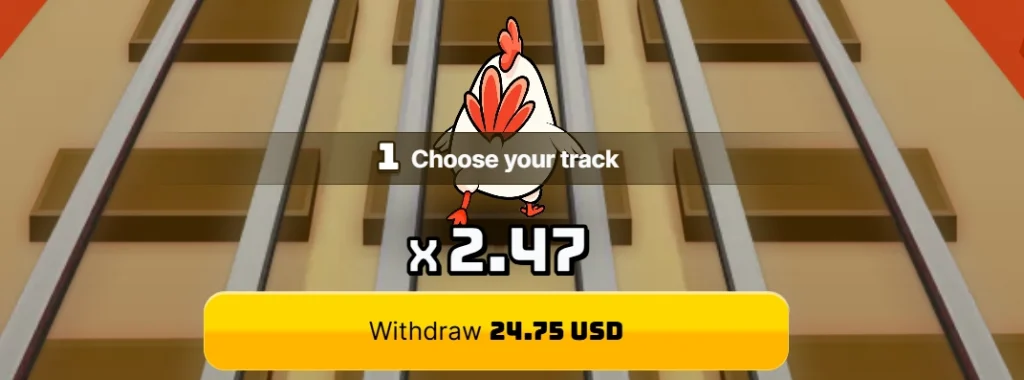
The Cash Out button. Pressing it converts a growing number into a fixed one, and the brain registers that as closing a door rather than banking a win. That resistance you feel is loss aversion working as intended; the section below dissects it.
The bust event. The train hit is loud, visual and slightly humiliating on purpose. A vivid ending makes the loss memorable and the near-miss more provocative, shortening the gap before you bet again. Design, not accident.
Chicken Subway Cashout Strategy: the Psychology of the Decision
If the maths is simple, why is the game hard to play well? Because the difficulty was never mathematical. Four mechanisms do most of the work.
The near-miss effect. You cash out at 3x; the round runs on and busts at 9.8x. Nothing was lost, the profit is banked, yet it stings like a defeat. Behavioural economics has documented this for decades: outcomes framed as almost are processed as losses even when they are wins. The game shows you the would-have-been multiplier deliberately. A clean loss closes a chapter; a near-miss opens one.
The illusion of control. Physically choosing lanes creates a sense of agency that one-button crash games never manage. Your finger did something, so your judgement feels implicated in the result that predated it. Agency feels like influence; here they are different things.
Loss aversion. Losses register roughly twice as strongly as equivalent gains, which is why a bust at 6x hurts out of all proportion to the stake, and why Cash Out feels heavier the higher the multiplier climbs. Pressing it stops a growing number, and the brain files that as a small loss even inside a win.
The one-more-round loop. At 15-30 seconds per round, there is no natural pause to evaluate a session. A frustrating result sits 20 seconds from a possible correction, so sessions extend one small decision at a time, none of which felt like a decision to keep playing.
None of this makes you a fool; it makes you a human playing a game built by people who understand humans. The mechanisms only work at full strength while invisible. Knowing them by name is the closest thing to an advantage this game permits, and it is also what responsible play looks like in practice: decisions made before the timer, not during it.
Fog Rounds, Safety Windows and Random Events
Two random events punctuate longer sessions. Fog Rounds reduce visibility on the tracks and tilt the round towards higher risk and higher reward; Safety Windows briefly clear lanes and lower the immediate danger. Both are triggered by the RNG, not by anything you did or any streak you were on, however strongly the timing suggests otherwise.
Why did 100HP add them? Two reasons. First, variety: identical rounds would get stale quickly at this pace. Second, and more interestingly, they break pattern recognition. Players are relentless pattern-finders, and a session of uniform rounds invites theories about rhythms and streaks. Random events scramble the sample, keeping the game feeling alive precisely because you cannot model it. Treat both events as scenery with adjusted odds, and adjust your target, or sit the round out, accordingly.
Easy and Hard Mode Explained
Under the surface, Chicken Subway rotates between internal configurations that players have nicknamed Easy and Hard mode. In an Easy phase, busts arrive rarely and the multiplier climbs sedately; in a Hard phase, the window compresses and the trains, in every sense, run faster. You do not choose the mode, you are not told which one you are in, and the switch is invisible.
The practical implication is worth spelling out. A hot streak that feels like your reading of the game improving may simply be an Easy phase, and the transition to Hard will not announce itself. Building confidence, or worse, raising stakes, on the back of a streak means building on a parameter you cannot see and did not earn. The rotation is one more reason streak-based reasoning fails here.
Demo Mode
The demo runs without registration, uses virtual credits and, crucially, runs the same RNG and the same maths as real play. It is not a softened version designed to flatter you into depositing. That makes it genuinely useful for three specific jobs:
Calibrating your personal cashout threshold with no financial pressure distorting the choice, so you learn what 3x discipline actually feels like.
Observing bust frequency across multiplier ranges, replacing your intuition about how often runs reach 5x with a sample of actual rounds.
Rehearsing your reaction to Fog Rounds and Safety Windows before real money is attached to the surprise.
One honest caveat: the demo does not predict real-money results, because every round’s RNG is independent. Fifty virtual rounds describe the game’s texture, not your next session. Our suggestion: 30-50 demo rounds before the first real stake, enough to make the mechanics boring, which is exactly the mindset to bring to real play.
Mobile Play
The game is built in HTML5 and runs in any modern mobile browser; there is nothing to install. Portrait mode is the intended layout, keeping all three lanes and the Cash Out button on screen at once, which matters in a game where the critical button must never be a scroll away.
Two mobile-specific warnings. The 5-second lane timer does not care about your signal, so a wobbly 4G connection on a train (the irony is noted) can eat decision time or delay a cashout; play on stable connections. And no legitimate Chicken Subway APK exists. Any downloadable file claiming to be the game’s app is somebody else’s software wearing its branding, and should be treated accordingly.
Bankroll Principles
Framing first: this is session management, not a winning strategy; no staking pattern changes the negative expected value. What it decides is how long your money lasts and how calm you stay.
Stake 1-2% of bankroll per round. With £200 set aside, that means £2-£4 bets, which survive a bad ten-round stretch without drama. £20 bets do not.
Set a session loss limit before opening the browser. A limit chosen mid-session is negotiated by the brain that just watched a 9.8x near-miss, and it negotiates badly.
Fix your target multiplier before the round starts. A target set in advance is a plan; a target set at 3.9x is a mood.
Avoid Martingale doubling here especially: rounds are so fast that five straight losses, turning a £2 bet into a £64 one, take under three minutes.
Pick an archetype and admit it. The Commuter cashes out early and often; the Daredevil rides for double digits and busts spectacularly. Their sessions feel completely different and face the same house edge. Neither is wrong; pretending to be one while playing like the other is.
The obligatory line, meant sincerely: no method changes the negative expected value of every round. Bankroll principles buy time and composure, nothing more. 18+ only; if losing the money would matter, the correct stake is zero.
Chicken Subway vs Crash Games
Against Aviator, the difference is decision density. Aviator asks one question per round, when to leave a rising curve, and everything before that is watching. Chicken Subway asks that question plus a lane choice at every step, so a round involves several judgement calls instead of one. Whether that is richer gameplay or simply more opportunities to second-guess yourself depends on your temperament.
Against JetX, the contrast is presentation and company. JetX is graph-based and leans social, with other players’ bets and cashouts on screen. Chicken Subway drops the social layer entirely and spends the budget on visual immersion instead: you against the trains, nobody watching.
The closest mechanical relative is actually Mines (or Tower-style games): step-by-step progression, a pre-determined hazard, a bank-or-continue choice at each stage. Chicken Subway is essentially Mines with a pulse, the same skeleton dressed in tempo, animation and a chicken.
Responsible Gambling
The straightforward part, said plainly. Chicken Subway is entertainment with a cost attached, not a source of income; the maths on this page guarantees the direction of travel over time. Play with money whose loss changes nothing about your week, and stop when it stops being fun rather than when it stops being affordable. UK players have strong tools available: GamStop (gamstop.co.uk) offers free self-exclusion across all licensed British operators, BeGambleAware.org provides free confidential advice, and licensed operators are required to offer deposit and loss limits, which work best when set before you need them. 18+ only.
Verdict: Who Is Chicken Subway For?
An honest sorting, with no sale attached. The game suits players who find graph-based crash titles passive and want their hands involved: several decisions per round, immediate consequences, a rhythm that fits mobile sessions of ten spare minutes. It also suits people who want more agency than a slot offers without learning card-game strategy; the rules fit in a sentence and the depth is all in the self-control.
It does not suit fans of auto-play and lean-back sessions, players who want feature-heavy slots with bonus rounds, or anyone on a very restricted bankroll, because the pace consumes small budgets quickly. If you are unsure which side you fall on, the answer costs nothing: run 30-50 rounds in the free demo, watch your own reaction to the first near-miss, and decide with data. The chicken will wait.
FAQ
Does the lane I pick actually affect my odds?
It selects between pre-calculated risk thresholds: the higher-multiplier lane carries a higher chance the round ends at that step. It does not influence the RNG, because the outcome is generated before the round begins. You are choosing a risk profile, not dodging trains.
What is the difference between RTP and house edge in Chicken Subway?
They are the same fact from two angles. RTP (96-98%) is the share of all stakes the game returns over millions of rounds; house edge (2-4%) is the share it keeps. One number defines the other, and neither says anything reliable about a single evening’s session.
Why does Chicken Subway feel harder to stop than other crash games?
Three design choices stack: 15-30-second rounds leave no pause for reflection, lane choices create a feeling of agency, and displayed near-misses reframe banked wins as losses. Each is mild alone; together they make continuing the path of least resistance.
Can I improve at Chicken Subway through practice?
You can improve your discipline: sticking to pre-set targets, sizing stakes sensibly, reacting calmly to Fog Rounds. You cannot improve your odds, because outcomes are RNG-determined before each round starts. Practice makes the player steadier; it does not make the game beatable.
What happens if my internet cuts out mid-round?
The outcome already exists on the server, so a dropped connection does not erase it. Platforms typically resolve the round from the last recorded state, often attempting an automatic cashout at your last confirmed multiplier. A stable connection remains the sensible default given the 5-second timer.
How do I verify a round is provably fair in Chicken Subway?
Note the hashed server seed shown in the fairness panel before the round. Afterwards the seed is revealed: run it, your client seed and the round’s nonce through any independent SHA-256 calculator and compare the output with the pre-round hash. A match proves the result was fixed before your first choice.
Emily Carter
iGaming Researcher and Online Casino Strategy Expert
Emily Carter is an iGaming researcher with more than 8 years of experience in analyzing online casinos and digital gaming content. She specializes in reviewing game mechanics, RTP models, bonus structures, payment systems, and player-focused casino features. Over the years, Emily has worked with gaming review projects, affiliate platforms, and market research teams, helping them create clearer, more useful, and more transparent content for players. Her main focus is responsible gambling, fair casino comparisons, and explaining complex gaming systems in a simple, practical, and easy-to-understand way.